Posts

The Tagbanua and Palawano tribes: Why Representation Matters

Image
The Tagbanua and Indigenous People of Southern Palawan can be classified as one of the oldest tribes in the Philippine archipelago. We existed through the years with the guidance of our customary laws and the leadership of our Masikampo. But as years went by, the Tagbanua nation found itself on the fringes of the society. Poverty is rampant and brought a vicious cycle of under-representation in the local and national government. During his time as Masikampo, Ignacio Joya worked hard to connect us with the government; thus our grandparents remembered how life was better in the old days. Now his son, Masikampo Ruben Joya, is the leader of the Indigenous People and continues such legacy that his father left for members of the IP. He has laid out clear policies for education, health and alleviation of poverty. Masikampo Ruben Joya is in talks with the executive and judiciary branch of the Philippine government to make them aware of the Tagbanua's place in the society.  Pictured a...
The Tagbanua Tribe: Advocating For Education

Image
"Irit Irit", I was told. Illiterate, she meant. That was the description I was given when I asked a local Tagbanua about her child. That is the truth for most of the Tagbanua nation and Indigenous People of Palawan. Education is such a lofty pursuit for so many IPs.  Poverty, poor access and unsustainable processes are some of the factors involved. Masikampo Ruben Joya believes that education is the way out of poverty. He advocates strongly for it and has program proposals lined up for members of the IP. As a private individual or group, how can you help? Here is a short list: 1. Sponsor a child or interested members of the tribe who wants to go to college. Tuition fees range from $100-200 every 6 months depending on the school they go to. 2. School provisions like notebooks, bags, pens or pencils. 3. Clothing like school uniforms and shoes. 4. Transportation vehicles to pick them from the villages to their school. 5. Books for grade schoolers and c...

The Unsung Heroes of the Tagbanua

Image
Masikampu Ignacio "Ampun" Joya Happy 121st Independence Day, Philippines!  We celebrate this occasion and the valiant people who fought for our freedom.  Schools have taught us about the battles and feats of Emilio Aguinaldo, Andres Bonifacio, Jose Rizal, Apolinario Mabini, Gregorio Del Pilar and Juan Luna. But have you heard the adventures of our local Tagbanua leaders?  The Tagbanua nation existed and fought wars even before the Spaniards came to the Philippines. Stories were handed down generations about fierce Tagbanuas who fought for their people. Local Tagbanua heroes were never recognized by the government for their contributions in history. Here are some of our Tagbanua unsung heroes: Kinuyu - He was a legendary leader and third on the Masikampu line after Rimundu. As written by Dr. Robert Fox, it was during Kinuyu's reign when the infamous raids by the Moros happened. Wearied by the attacks, Kinuyu and the Moro ...

How To Become A Tagbanwa Masikampo

Image
The Masikampo is the supreme leader of the Tagbanua and the Indigenous People of Palawan. The title and position is inherited and the selection is done only by the Usba e't Masikampo or the princes/nobles of the Masikampo. Here are the requisites to become a Masikampo: 1. Osol      Not everyone can be a Masikampo. One must have the bloodline of a Masikampo.  2. Adat     The Tagbanua is a nation that has a set of customary laws that is being followed to this day. A person must be knowledgeable of these customary laws to be qualified as Masikampo. 3. Tuturan     This requirement basically entails knowing the genealogy and history of the Masikampo. 4. Surugiden      A Masikampo is expected to be trained and interested in jural procedures. This can only be learned through exposure during meetings of the elders and taught by the Masikampo to his son/sons. Such procedures are intricate and involves diplomacy and use o...

The Tagbanua Race

Image
An Article about the Tagbanua by Fe Tria Fernandez.  LINK HERE . http://www.pia.gov.ph/philtoday/pt03/pt0312.htm The Tagbanuas are original race of people inhabiting Palawan. They are by far the most numerous of the ethnic groups that inhabited Palawan during the pre-Hispanic times. They are the most cultured of the original people because they have an alphabet of their own. Tagbanua music basically makes use of three kinds of musical instrument. Agong is a brass instrument 1½ feet in diameter with a fist-sized node at the center. It is played by beating the node with a stick wrapped with strips of cloth. Babandil, another kind of musical instrument, is similar to the agong but only about four inches in depth. It is played with the use of the beater made of soft wood. The sound is mellower than the gong. The third kind of musical instrument is the gimbal similar to the snare drum. It is a hollow wood 1½ feet tall, five to 10 inches in diameter and covered at...

The Tagbanua Tribe

Image
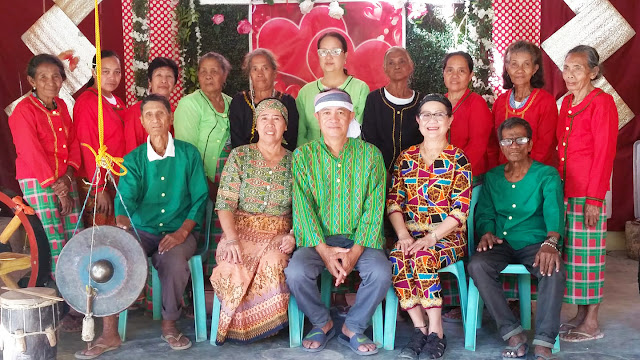
Seated L-R: Orancaya Rodenio Saco, Ba'e Estela M. Joya, Masikampo Ruben C. Joya, Usba e't Masikampo Leah Joya The Tagbanua today. They stick to "ugali," tradition, and the moral rules of "adat," customary law. Magellan's secretary, Pigafetta, observed the practice of bl ood brotherhood ritual in 1521 just as I did myself in 2009. The chief is named Masicampo. On the picture, he appears with his wife. Her function as the ba'e has even been recorded in early Spanish logs. So this is a pre-colonial cultural tradition still very much alive in the southern Philippines. It has many affinities with lifeways in other parts of Southeast Asia, above all, with Borneo. The lady on the right hand flank of the second row, Dominica, is a chief dancer. She has played an important role in my project, above all, in the translation of ritual speech. A Palawan collection in the Oslo University Museum of Cultural History now holds most of the material culture items ...

History of Aborlan

Image
The political center of Tagbanua tribe is in Aborlan, a town south of Inagawan where the former seat was held until the penal colony expanded. There are multiple stories about how the name of Aborlan came to be, but one that is being held by most tribal members is the one accounted in Dr. Robert Fox's book. The town's name came after Abalan , ?abal , which means "cloth". A report by the late Eulalio Palao dated 1953 accounted this version of the word " abel " or piece of cloth which came from a certain species of tree. Since the Tagbanua and other IPs of Palawan existed before the Spanish colonization, we affirm this origin of the town's name. Identity is important to everyone and knowing our roots, our history, ensures that we have a foundation that will flourish through the ages. Abelnan. Sources: Dr. Robert Fox, Tagbanua Religion and Society National Museum Image: Excerpt from Eulalio Palao, Principal, Aborlan Elementary School, April 21,...