Posts

Showing posts with the label Culture and traditions of the Tagbanua

The Tagbanua Dance: Kendar

Image
  There are many Tagbanua dances but we generally call it KENDAR. Depending on the occasion or ritual, the Tagbanua has a varied repertoire of dances. Attribution: Masicampo Ruben C. Joya Usba et Masikampo Rikizam M. Joya, MD Usba et Masikampo Ashelon M. Joya Usba et Masikampo Ruben M. Joya, II Maradja et Masikampo Redeem M. Joya Location: Aborlan, Palawan Philippines

The Tagbanua Script: Surat et Tagbanua

Image
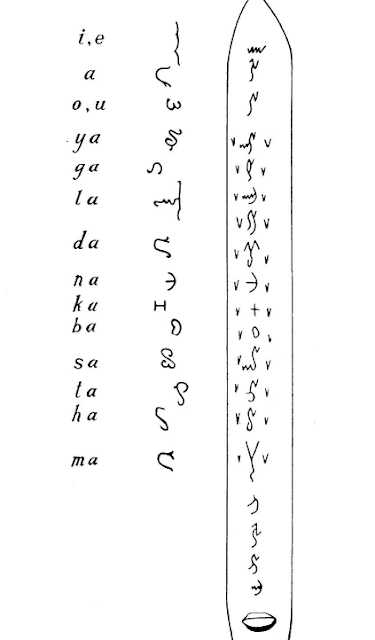
  The Tagbanua script (SURAT) preserved some of the Hindu ancient writing. It is written in vertical columns reading from top to bottom and the columns following in order from right to left. The inscriptions consists of incisions in the surface of strips of bamboo. In the picture, the one on the right is the modern Tagbanua script. The middle shows the Tagalog script and the left image shows the value of the letters in Roman characters. Masikampu Ignacio "Ampun' Cursod Joya, the 14th Masikampu of the Tagbanua and IPs of Palawan, used to write this way. Reference: Peoples of the Philippines by Albert Louis Kroeber, 1876-1960. Publication date: 1919. Courtesy of University of Michigan. Attribution: Masikampo Ruben C. Joya, 18th Masikampo of the Tagbanua and IPs of Palawan Usba et Masikampo Rikizam M. Joya, MD Usba et Masikampo Ashelon M. Joya Usba et Masikampo Ruben M. Joya, II Maradja et Masikampo Redeem M. Joya

The Tagbanua: Black Teeth

Image
  In the old days, the Tagbanua men and women would file and blacken their teeth. The upper and lower incisors were filed with a stone called u'urutan. The occluding surface would be filed to even them then the facial side to make it concave. The patient bit on a stick of wood during the procedure. After filing, the leaves of a vine called migay were rubbed on the face of the teeth. The black residue used to paint the teeth was made from chopped leaves of kabar and tambilikan- boiled until it turns black. The teeth were painted twice a year. Teeth blackening was supposed to protect the teeth and make it healthier. This custom was lost in the East Coast when the Christians came and eventually the Apuraw'non Tagbanuas stopped doing it. Teeth blackening (Ohaguro) is a custom used by the Japanese during the Meiji area. People from Southeast Asia and Oceania still practices it. Reference: Religion and Society Among the Tagbanwa by Dr. Robert Fox, 1982. Attribution: Masikampo Ruben C...

The Tagbanua: History of Inagawan

Image
Inagawan is an idyllic locale situated a few miles away from Puerto Princesa City in Palawan. The area used to be the seat of the Tagbanua Masikampo until it was moved to Aborlan. This is the place where Saint Ezequiel Moreno first met and baptized Patula (Manuel/Maning), the ninth Masikampu of the Tagbanua. Due to frequent Moro raids during that time, the Tagbanua used to call it “Riyumpakan” which roughly translates to “trampled on”. There are two classes of Tagbanua reside nts of Inagawan. The Matnoranun (from Matnor river) are called Daya’nun which meant people living on the mountains. They are agricultural people and known to be rich by Tagbanua standards. The Inagawnun or Laut’nun live on the valley and are the more civilized of the two. Inagawan has produced prominent personalities like Senator Ramon Villarosa Mitra and Jose Nolledo. For the Tagbanua, we take pride with the history of our ancestry. We honor and give recognition to our very own- Apo Felisa Sar...

The Masikampo: Supreme Leader of the Tagbanua

Image
Masikampu Ruben C. Joya fulfilled all these requirements of a Masikampo. 1. One must have a Bloodline of a Masicampo known as Osol . He is the direct descendant of Masikampu Ignacio Joya (14th Masikampu), son of Apo Rafaela Kursud. Only a direct descendant of the Inagawan Masikampu can be chosen by the Usba et Masikampu to lead the tribe. This is the Osol. Anyone who claims to be a Masikampu with out proof of Osol is considered a fraudulent entity. 2. He must be knowledgeable of the customary laws of the Tagbanuas known as Adat . Masikampu Ruben Joya learned the customary laws through his father and Usba et Masikampu. The Adat should not be taken lightly. There is a blessing and a curse if you do not perform your duties as the supreme leader of the Tagbanua. This is one reason why young children are not allowed to be the head of the Tagbanua despite being an Usba et Masikampu. 3. He must be knowledgeable of the history of the Masicampo known as Tuturan . He was taught and educa...

A Tagbanua Short Story: Wali and the Bangat

Image
Wali, a hunter from Tigman, was once lost in the forest for seven days and nights. He found the place at the head of the Maasin River where there were countless pigs. As he wandered there, he saw some huge houses with hundreds of rooms. These houses had roofs but no floors. When he saw the huge houses he was afraid. But he said to himself, I will go there even it is the place of the damdam [an evil spirit] for I am too tired to conti nue. As he approached one of the houses he met a very old man. It was a panya’an, the leader of the pigs, named li’iyan kat baga. The old man said to him: “Why have you come to my house?” Wali replied: “I am lost.” The old man then told him to enter one of the houses. After he had entered they chewed betel and Wali was given food. But the rice was soft-cooked with the chaff. When the meal was over the old man told Wali not to leave as his children were coming. Late that afternoon Wali saw thousands of small pigs approaching. They all dove into ...

The Tagbanua Stories: The Suday

Image
Countless suday (a human-like spirit) are said to live in the sea and to swarm along the shores at night. The Tagbanuwa state that it is unsafe to sleep on the beach at night, particularly alone. These spirits are said to gather by the hundreds around the sleeper and to scratch their fingernails up and down his body. Then they stab the sleeper in the belly with their foot-long thumbnails.  (Robert B. Fox [Tagbanuwa Religion and Society] page 170) credit to the Office of Masicampo Ruben C. Joya Sr. [special thanks to Director Jeremy Barnes of the Philippine National Museum] portrayed image attributed to  https://beautilation.tumblr.com/post/31992015613

Traditional Tagbanua Wedding: Requirements and Process of the Event

Image
The Tagbanua wedding is a multi-step process and here is a summarized, but not exhaustive list of the occasion.  1. Surugiden- The couple should undergo this process with their parents/guardians and at least two (2) Bagerals in attendance. This will enable both parties to investigate and agree that the couple are eligible for marriage. 2. Sanggup- This is the process wherein the families agree on terms of marriage. 3. Surong et kapangasawa- Provision of support including, but not limited to monetary endowment (bandi). 4. Ceremony officiated by Masikampo Ruben Joya- The ceremony is led by the Tagbanua/IP Masikampo. He is trained and licensed to officiate Indigenous People's weddings by virtue of his status as head of the Tagbanua. 5. Da-ton- An offering for a successful marriage usually done by the Manlalambay 6. Tabad- Rice wine drinking as part of the ceremony 7. Sakluban et tapis- The bride and groom are covered in a ceremonial blanket. 8. Mang-mang- Or, pr...

The Tagbanua: Marriage Traditions

Image
Did you know that in recent years the Tagbanua adhere to the rule of Matrilocality? It occurs when the newly-weds build their house in the maternal residential area of the village (the area of matrilocality is the natal village of the woman). It also means that if the parents of the girl should move to another village, the sons-in-law and their elementary families should follow. The only rationale given for matrilocal residence is that it strengthens the bilateral family; it  would add an economically productive man and woman to the local kinship group of the girl's parents. Matrilocal residence also placed the girl's parents in an effective position for exercising primary authority. Forced separation is one technique used by the girl's parents to enforce their control over their sons-in-law. Polygyny (in which a man has more than one wife) is also restricted by the custom of matrilocal residence as it becomes necessary for men to obtain wives from a single village. ...

The Tagbanua and Palawano tribes: Why Representation Matters

Image
The Tagbanua and Indigenous People of Southern Palawan can be classified as one of the oldest tribes in the Philippine archipelago. We existed through the years with the guidance of our customary laws and the leadership of our Masikampo. But as years went by, the Tagbanua nation found itself on the fringes of the society. Poverty is rampant and brought a vicious cycle of under-representation in the local and national government. During his time as Masikampo, Ignacio Joya worked hard to connect us with the government; thus our grandparents remembered how life was better in the old days. Now his son, Masikampo Ruben Joya, is the leader of the Indigenous People and continues such legacy that his father left for members of the IP. He has laid out clear policies for education, health and alleviation of poverty. Masikampo Ruben Joya is in talks with the executive and judiciary branch of the Philippine government to make them aware of the Tagbanua's place in the society.  Pictured a...

The Unsung Heroes of the Tagbanua

Image
Masikampu Ignacio "Ampun" Joya Happy 121st Independence Day, Philippines!  We celebrate this occasion and the valiant people who fought for our freedom.  Schools have taught us about the battles and feats of Emilio Aguinaldo, Andres Bonifacio, Jose Rizal, Apolinario Mabini, Gregorio Del Pilar and Juan Luna. But have you heard the adventures of our local Tagbanua leaders?  The Tagbanua nation existed and fought wars even before the Spaniards came to the Philippines. Stories were handed down generations about fierce Tagbanuas who fought for their people. Local Tagbanua heroes were never recognized by the government for their contributions in history. Here are some of our Tagbanua unsung heroes: Kinuyu - He was a legendary leader and third on the Masikampu line after Rimundu. As written by Dr. Robert Fox, it was during Kinuyu's reign when the infamous raids by the Moros happened. Wearied by the attacks, Kinuyu and the Moro ...

How To Become A Tagbanwa Masikampo

Image
The Masikampo is the supreme leader of the Tagbanua and the Indigenous People of Palawan. The title and position is inherited and the selection is done only by the Usba e't Masikampo or the princes/nobles of the Masikampo. Here are the requisites to become a Masikampo: 1. Osol      Not everyone can be a Masikampo. One must have the bloodline of a Masikampo.  2. Adat     The Tagbanua is a nation that has a set of customary laws that is being followed to this day. A person must be knowledgeable of these customary laws to be qualified as Masikampo. 3. Tuturan     This requirement basically entails knowing the genealogy and history of the Masikampo. 4. Surugiden      A Masikampo is expected to be trained and interested in jural procedures. This can only be learned through exposure during meetings of the elders and taught by the Masikampo to his son/sons. Such procedures are intricate and involves diplomacy and use o...

The Tagbanua Race

Image
An Article about the Tagbanua by Fe Tria Fernandez.  LINK HERE . http://www.pia.gov.ph/philtoday/pt03/pt0312.htm The Tagbanuas are original race of people inhabiting Palawan. They are by far the most numerous of the ethnic groups that inhabited Palawan during the pre-Hispanic times. They are the most cultured of the original people because they have an alphabet of their own. Tagbanua music basically makes use of three kinds of musical instrument. Agong is a brass instrument 1½ feet in diameter with a fist-sized node at the center. It is played by beating the node with a stick wrapped with strips of cloth. Babandil, another kind of musical instrument, is similar to the agong but only about four inches in depth. It is played with the use of the beater made of soft wood. The sound is mellower than the gong. The third kind of musical instrument is the gimbal similar to the snare drum. It is a hollow wood 1½ feet tall, five to 10 inches in diameter and covered at...

The Tagbanua Tribe

Image
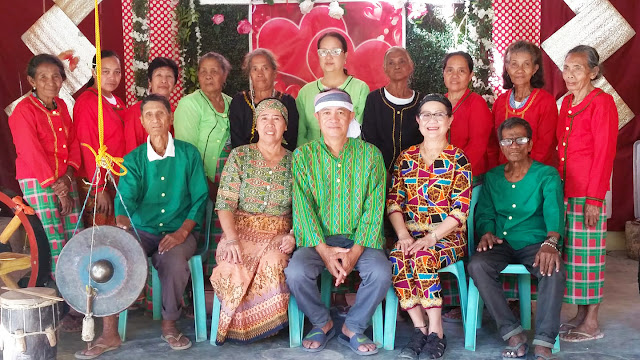
Seated L-R: Orancaya Rodenio Saco, Ba'e Estela M. Joya, Masikampo Ruben C. Joya, Usba e't Masikampo Leah Joya The Tagbanua today. They stick to "ugali," tradition, and the moral rules of "adat," customary law. Magellan's secretary, Pigafetta, observed the practice of bl ood brotherhood ritual in 1521 just as I did myself in 2009. The chief is named Masicampo. On the picture, he appears with his wife. Her function as the ba'e has even been recorded in early Spanish logs. So this is a pre-colonial cultural tradition still very much alive in the southern Philippines. It has many affinities with lifeways in other parts of Southeast Asia, above all, with Borneo. The lady on the right hand flank of the second row, Dominica, is a chief dancer. She has played an important role in my project, above all, in the translation of ritual speech. A Palawan collection in the Oslo University Museum of Cultural History now holds most of the material culture items ...

History of Aborlan

Image
The political center of Tagbanua tribe is in Aborlan, a town south of Inagawan where the former seat was held until the penal colony expanded. There are multiple stories about how the name of Aborlan came to be, but one that is being held by most tribal members is the one accounted in Dr. Robert Fox's book. The town's name came after Abalan , ?abal , which means "cloth". A report by the late Eulalio Palao dated 1953 accounted this version of the word " abel " or piece of cloth which came from a certain species of tree. Since the Tagbanua and other IPs of Palawan existed before the Spanish colonization, we affirm this origin of the town's name. Identity is important to everyone and knowing our roots, our history, ensures that we have a foundation that will flourish through the ages. Abelnan. Sources: Dr. Robert Fox, Tagbanua Religion and Society National Museum Image: Excerpt from Eulalio Palao, Principal, Aborlan Elementary School, April 21,...

The Indigenous People Of Palawan: Tagbanua Masikampo

Image
The anointing and "lambay" of Masikampo Ruben C. Joya The island of Palawan stands famous for its scenic and serene beaches. International magazines and travel websites consistently ranked Palawan as one of the best in the world. Aside from the natural features of the landscape, the island of Palawan is also known for its people. There is a rich demographic diversity in the island owing to the multiple ethnic tribes calling Palawan their home. The Tagbanua tribe is one of the oldest indigenous tribes thriving in the archipelago. It exists with rich and elaborate culture and traditions which is being practiced especially by tribal members in the Central coast of Palawan. At the helm of the Tagbanua society is the Masikampo (Masicampo). Considered as the highest political leader of the cultural communities of Palawan, the Masikampo works to preserve the cultural integrity and secure the well-being of the province's indigenous people. According to history, the Masikampo...

The Tagbanua Nobles: Masikampu Ignacio Joya

Image
Masikampu Ignacio Joya (the 14 th Masikampu) who was considered as the environmental protector of the ancient lands and sacred sites of Palawan, had the title MASIKAMPU or the Master of the Camp ( Antropologist Harold Olofson ); the Tagbanuas, however, quoted it for “Mas it Ampu” or higher than Lords ( Ancient Syllabaries ). This indicates why the Masikampu seats as the highest titular head of the earliest form of government known in the province. All affairs, even those of the past, present and future manifestations of the culture of Palawan must be with the consent and authority of the Masikampu .   Ampun, who was the eldest grandson of Kursud, was treated by his grandfather as his own son. He was   also trained to become a Masikampu as he did with his sons. Since Ampun did not have a real father, Kursud has become his paternal figure as he also lives with him. Relatively, Ampun, was only younger by one year than Emilio, the youngest son of Kursud with...

The Tagbanua: Marriage Vows

Image
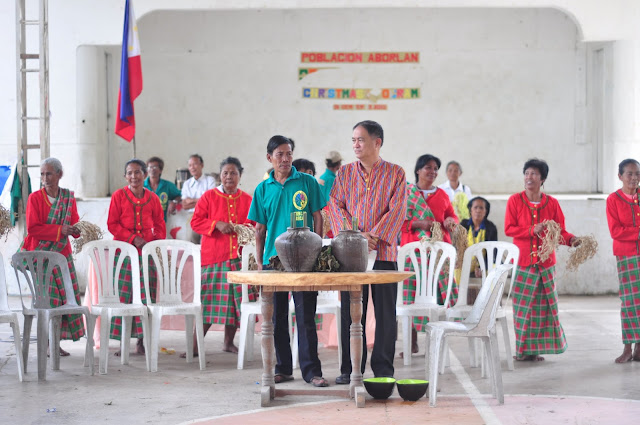
Marriage among the Tagbanua and Pala'wan is a multi-step process that is intrinsically part of the tribal tradition. Before the actual exchange of vows, the families involved, the nobles (usba) and bagerals meet to discuss the terms of marriage. There is a form of inquiry about the civil status of both parties to make certain that there are no binding legal responsibilities. The family of the bride might ask for a dowry which can be monetary or livestock for farm use. The requests are not exorbitant or limiting. There usually is a compromise agreeable to the involved families. Once an agreement is made, the wedding ceremony commences with a "lambay", a ritual, offered to the gods to bless the union. The Masikampo, the supreme leader, solemnizes the wedding as is the custom. As part of the event, there is food, "tabad" (rice wine) and a lot of dancing and "uyman" (singing). Above is a couple from Sagpangan in Aborlan whose wedding was officiated...

The Tagbanua: Future Untold

Image
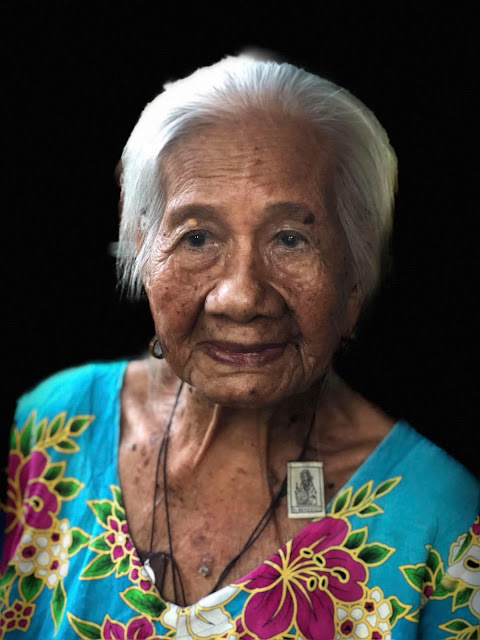
What does the future hold for the Tagbanua and the Indigenous people of Palawan? Multiple generations passed and here we stand with our children in a society that has changed by the turn of the century. Our forefathers who used to be gatherers, farmers and fisherfolk were brought up with poor to no formal education. Living up on the boondocks and far from state-sponsored schools, a good number of the population did not have the opportunity to get basic or higher education. The small number of those who were close to the main towns were either too poor to afford the cost of education or stigmatized based on stories of old. How will the story unfold with the new generation of tribal members? Will we take up to the challenge of bringing our families out of poverty by striving to be educated and working to better the tribe? We must.

Tagbanua: A Simple Life

Image
The Tagbanua and most of the Indigenous People in the South of Palawan dream of a simple life. It is a life that revolves around family, the tribe and society, itself. Every member of the tribe endeavors to provide sustenance to their family and uplift themselves from the rigorous poverty that encumbers everyone. There is really no opportunity available or reachable for most of the Tagbanua. The cycle of helplessness is palpable, but we hope and fight for an equal opportunity to survive and realize these dreams in the near future.