Posts

Showing posts with the label Philippine History

The Tagbanua: Marriage Traditions

Image
Did you know that in recent years the Tagbanua adhere to the rule of Matrilocality? It occurs when the newly-weds build their house in the maternal residential area of the village (the area of matrilocality is the natal village of the woman). It also means that if the parents of the girl should move to another village, the sons-in-law and their elementary families should follow. The only rationale given for matrilocal residence is that it strengthens the bilateral family; it  would add an economically productive man and woman to the local kinship group of the girl's parents. Matrilocal residence also placed the girl's parents in an effective position for exercising primary authority. Forced separation is one technique used by the girl's parents to enforce their control over their sons-in-law. Polygyny (in which a man has more than one wife) is also restricted by the custom of matrilocal residence as it becomes necessary for men to obtain wives from a single village. ...

The Tagbanua and Palawano tribes: Why Representation Matters

Image
The Tagbanua and Indigenous People of Southern Palawan can be classified as one of the oldest tribes in the Philippine archipelago. We existed through the years with the guidance of our customary laws and the leadership of our Masikampo. But as years went by, the Tagbanua nation found itself on the fringes of the society. Poverty is rampant and brought a vicious cycle of under-representation in the local and national government. During his time as Masikampo, Ignacio Joya worked hard to connect us with the government; thus our grandparents remembered how life was better in the old days. Now his son, Masikampo Ruben Joya, is the leader of the Indigenous People and continues such legacy that his father left for members of the IP. He has laid out clear policies for education, health and alleviation of poverty. Masikampo Ruben Joya is in talks with the executive and judiciary branch of the Philippine government to make them aware of the Tagbanua's place in the society.  Pictured a...

How To Become A Tagbanwa Masikampo

Image
The Masikampo is the supreme leader of the Tagbanua and the Indigenous People of Palawan. The title and position is inherited and the selection is done only by the Usba e't Masikampo or the princes/nobles of the Masikampo. Here are the requisites to become a Masikampo: 1. Osol      Not everyone can be a Masikampo. One must have the bloodline of a Masikampo.  2. Adat     The Tagbanua is a nation that has a set of customary laws that is being followed to this day. A person must be knowledgeable of these customary laws to be qualified as Masikampo. 3. Tuturan     This requirement basically entails knowing the genealogy and history of the Masikampo. 4. Surugiden      A Masikampo is expected to be trained and interested in jural procedures. This can only be learned through exposure during meetings of the elders and taught by the Masikampo to his son/sons. Such procedures are intricate and involves diplomacy and use o...

The Tagbanua Nobles: Masikampu Ignacio Joya

Image
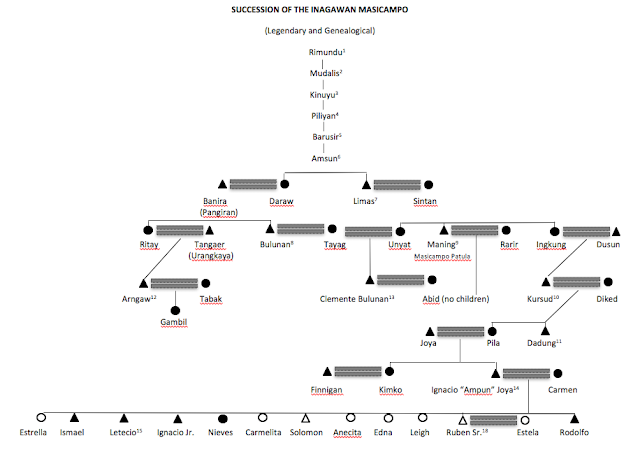
Masikampu Ignacio Joya (the 14 th Masikampu) who was considered as the environmental protector of the ancient lands and sacred sites of Palawan, had the title MASIKAMPU or the Master of the Camp ( Antropologist Harold Olofson ); the Tagbanuas, however, quoted it for “Mas it Ampu” or higher than Lords ( Ancient Syllabaries ). This indicates why the Masikampu seats as the highest titular head of the earliest form of government known in the province. All affairs, even those of the past, present and future manifestations of the culture of Palawan must be with the consent and authority of the Masikampu .   Ampun, who was the eldest grandson of Kursud, was treated by his grandfather as his own son. He was   also trained to become a Masikampu as he did with his sons. Since Ampun did not have a real father, Kursud has become his paternal figure as he also lives with him. Relatively, Ampun, was only younger by one year than Emilio, the youngest son of Kursud with...

The Tagbanua Masikampo: A Noble Lineage

Image
        From the phrase ‘mas et ampu” or “higher than lords” this title is not based upon Spanish term “Maestro de campo” which Dr. Fox states that its origin may at least be one hundred fifty years or older.   The term “mas” means “greater” and “ampu” means “lord” with “ampuan” meaning “Lord” or “Maguindusa”, the Supreme God of the Tagbanuas. This rank is considered as higher than the Datu but lesser than the Sultan. By virtue of the authority of the Masicampo and based on intergenerational knowledge passed to the present successor, the term “Maestro de Campo” is hereby corrected in accordance with the right of cultural integrity.       The Masicampo is a vassal from the Sultan of Burnay (Brunei) who first established the civil hierarchy long before the colonization of Spain in the Philippines. It was a legend that the Masicampo is the son of the Sultan of Brunei by reason of the legend of Inagawan, the seat of t...